NASA's Rocket Lab-built ESCAPADE twins complete first powered Earth flybys, now bound for Mars
NASA's twin ESCAPADE smallsats, built by Rocket Lab, completed the first powered Earth flybys used to send NASA spacecraft to Mars on Nov. 7 and Nov. 9, 2026, and are due to reach Mars in September 2027.
NASA's two ESCAPADE (Escape and Plasma Acceleration and Dynamics Explorers) spacecraft each completed a powered Earth flyby, the first spacecraft at about 5 a.m. EST (11:00 CET) on Saturday, Nov. 7, 2026 and the second at about 6 a.m. EST (12:00 CET) on Monday, Nov. 9, according to NASA (confirmed). Both are now on a roughly 10-month cruise to Mars.
What happened
- A first for NASA (confirmed): "This is the first time NASA has used a powered Earth flyby to propel a spacecraft toward Mars, and we've now executed this maneuver twice, flawlessly, in just two days," said Asal Naseri, acting associate flight director for NASA's Heliophysics Division, in the agency statement.
- The burns (confirmed): At closest approach each spacecraft fired its engine for about 9 minutes in a trans-Mars injection burn. NASA puts the first spacecraft about 1,000 miles above Earth during its burn and the second about 650 miles up.
- Who built them (reported): SpaceNews describes the twins as Rocket Lab-built spacecraft. The mission is led by UC Berkeley's Space Sciences Lab, and principal investigator Rob Lillis said the burns "were executed perfectly."
- An unusual route (confirmed): ESCAPADE launched from Cape Canaveral on Nov. 13, 2025, on the second flight of Blue Origin's New Glenn, when Earth and Mars were on opposite sides of the Sun. Instead of waiting for the usual Mars window, which opens about every 26 months, the pair loitered around the Earth-Sun Lagrange point 2 and came back for the slingshot. SpaceNews reports the trajectory was designed by Advanced Space.
- Next milestones (confirmed): Mars orbit insertion burns of about 11 minutes are planned for Sept. 7 and Sept. 9, 2027, and NASA expects science operations to begin in June 2028. The twins will study how the solar wind strips the Martian atmosphere.
Why it matters for space investors
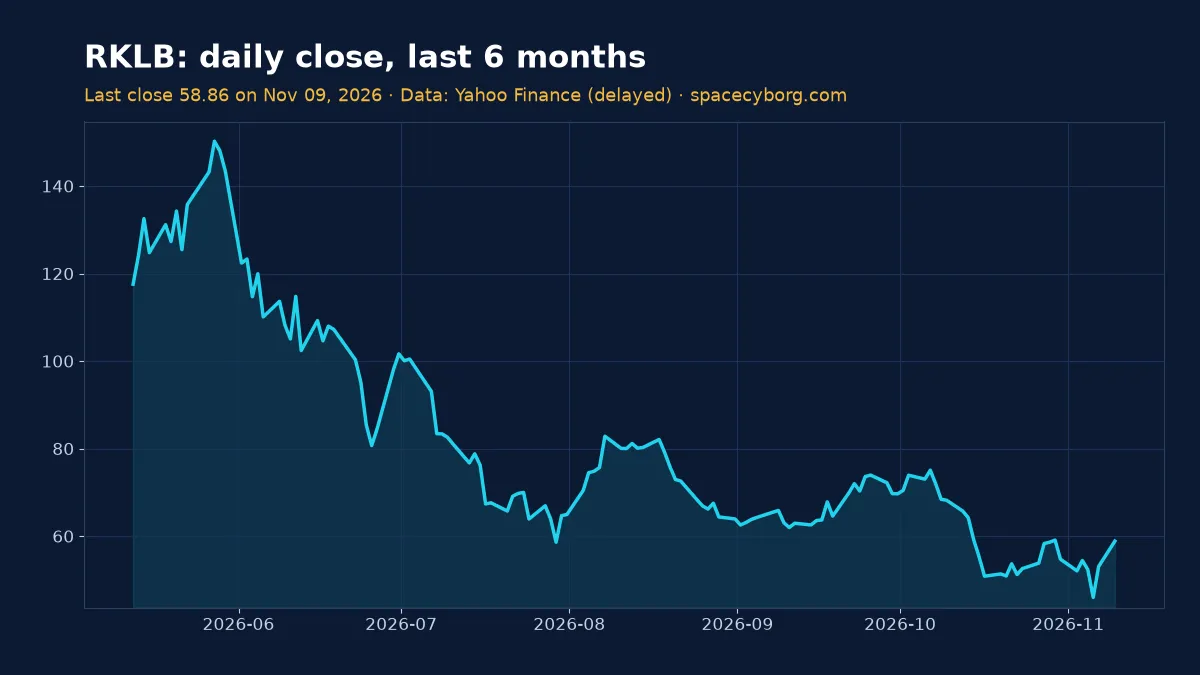
ESCAPADE is a working demonstration of two commercial threads at once: low-cost planetary spacecraft from Rocket Lab (RKLB), whose chart is shown above, and a Mars launch approach that does not depend on the two-year planetary alignment. If the technique becomes routine, launch providers and spacecraft makers could sell Mars missions on far more flexible schedules. The mission still has to survive the cruise and its orbit insertion burns in 2027, and SpaceNews notes that NASA has not solicited new missions under the low-cost SIMPLEx program that funded ESCAPADE, so near-term follow-on demand is unclear. Track upcoming launches and company updates on the calendar.
Not financial advice.