NASA opens $10B CLPS 2 lunar delivery pool to eight firms, picks Blue Origin to land nuclear PROMISE rover
NASA named eight companies for CLPS 2, a 10-year lunar delivery contract with a $10 billion ceiling, raised CLPS 1.0 to $4.2 billion and gave Blue Origin a $94 million base award to land the nuclear PROMISE rover.
NASA on Saturday, November 7, 2026, named eight companies for CLPS 2, the next phase of its Commercial Lunar Payload Services program, under a 10-year contract with a combined maximum value of $10 billion, according to the agency's press release (confirmed). The awards were announced at the MAX POWER expo at Kennedy Space Center as part of NASA's Moon Base program for the lunar South Pole.
What happened
- CLPS 2 selections (confirmed): Blue Origin, Firefly Aerospace, Intuitive Machines, ispace-U.S., Lockheed Martin Space, Northrop Grumman Space Systems, SpaceX and Voyager Technologies are now eligible to compete for individual lunar delivery task orders. It is an indefinite-delivery/indefinite-quantity (IDIQ) contract, so the $10 billion is a ceiling, not committed spending.
- CLPS 1.0 expanded (confirmed): NASA raised the existing CLPS contract from $2.6 billion to $4.2 billion to support Phase One Moon Base objectives. It stays open through November 2028, with deliveries allowed through November 2033.
- PROMISE rover (confirmed): NASA is moving ahead with PROMISE (Polar Rover for Observation, Mapping, and In-Situ Exploration), a six-wheeled, nuclear-powered rover built by JPL from spare and test hardware from the Curiosity and Perseverance Mars programs. It will carry a drill reaching about 1 meter below the surface to characterize ice, plus spectrometers, sensors and cameras. Launch is targeted for late 2028, with an 18-month mission (NASA mission page).
- Blue Origin delivery award (confirmed): Blue Origin received a $94 million base contract, with a performance-based option worth up to $140 million more, to land PROMISE on its Mark 1 lander.
- Transport task orders (confirmed): Six VADR task orders worth about $1.3 billion combined went to Arrow Science and Technology, Blue Origin and Impulse Space. Missions will use New Glenn, Relativity's Terran R and Falcon 9, with in-space transport from Blue Origin, Firefly, Impulse Space and Quantum Space. Separately, SpaceX will launch cislunar communications satellites on Starship in 2028.
- Surface power (confirmed): For the miniCAST power-and-communications tower, NASA picked Honeybee Robotics (a Blue Origin company), Redwire and Yank Technologies, with a separate integrated-power solicitation expected in early 2027.
Why it matters for space investors
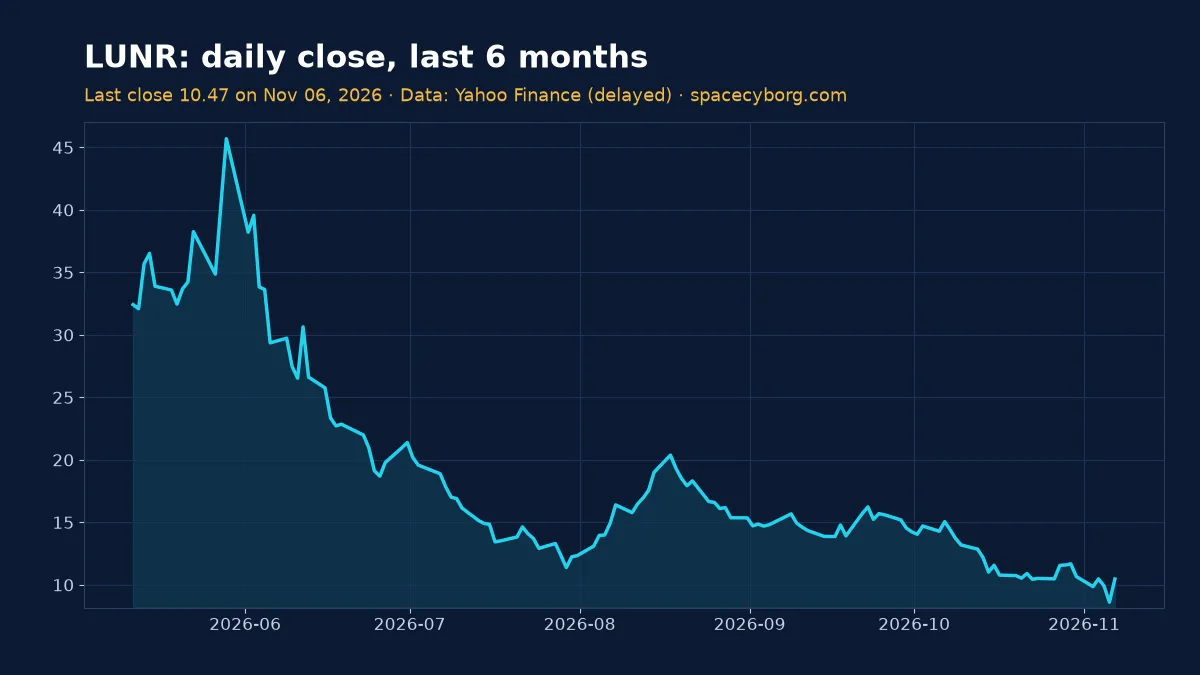
Listed names on the CLPS 2 roster include Intuitive Machines, Firefly Aerospace, Voyager Technologies, Lockheed Martin and Northrop Grumman, and Redwire picked up a surface-power award. A bigger IDIQ pool widens the addressable market for lunar landers, but revenue only arrives when individual task orders are won and flown, and eight competitors will be bidding for them. Watch for the first CLPS 2 task orders and for how quickly NASA draws down the expanded CLPS 1.0 ceiling. SpaceX and privately held Blue Origin appear in nearly every category, which underlines how much the Moon Base plan relies on heavy-lift launch. Track upcoming missions on our launch calendar, and see our earlier coverage of Artemis III and Blue Moon.
Not financial advice.